

The Impact of Death Denial on Politics
Why fear quietly governs more than we realise.

Your weekly dose of living fully
If you want to understand modern politics, do not start with ideology.
Start with fear.
Not fear as an abstract idea, but fear in the body. Fear of loss. Fear of threat. Fear of disappearing. Fear that something essential is about to be taken away.
Beneath almost every political slogan, culture war, or polarising headline, there is an older fear at work. The fear of death. The silent, Grandmother fear, from which other fears grow... such as the fear of vulnerability, impermanence, and loss of control.
The subject of death is taboo in the west (despite it being the only thing in life that is guaranteed) and as a result, we rarely name this ancient fear. But it shapes far more of our political landscape than we like to admit.
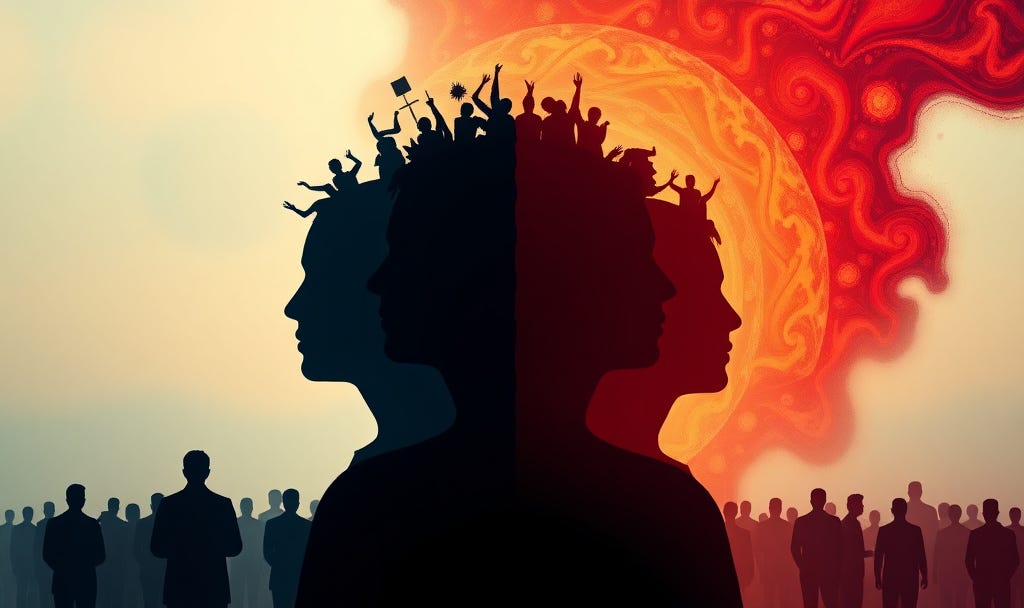
Fear as a Tool of Power
Human beings are most easily influenced when they feel unsafe. History shows this again and again. When people believe their survival is under threat, they become willing to trade freedom for certainty, complexity for simple answers, and compassion for protection.
A body of psychological research calls this ‘Terror Management Theory’. Decades of research show that when people are reminded of mortality, even subtly, they are more likely to cling to strong leaders, rigid belief systems, and in group identities.
They become less tolerant of ambiguity and more hostile toward perceived outsiders. This is not a flaw in character. It is biology.
When fear of death is activated, the nervous system narrows. The world becomes smaller. The question shifts from what is true or just to what will keep me safe right now.
Political messaging that leans on existential threat does not need to convince. It only needs to trigger.
What makes this fear so potent today is not death itself, but our refusal to face it.
Modern societies do not teach us how to relate to mortality. We hide it, medicalise it, euphemise it, and push it to the edges of life.
Death becomes something unspeakable, unthinkable, and therefore terrifying. When a culture denies death, fear has nowhere to go but outward. It attaches itself to politics, identity, borders, bodies, and belief systems.
Death denial does not remove fear. It multiplies it.
From Fear to Polarity
Fear is where polarity is born.
When fear is high, nuance disappears. The world fractures into us and them. Good and bad. Safe and dangerous. Loyal and traitorous.
In domestic politics, this plays out as culture wars, scapegoating, and moral outrage cycles. Immigrants become threats rather than humans. Opposing voters become enemies rather than neighbours. Complex social problems are reduced to villains and slogans.
Data backs this up. Studies in political psychology show that heightened mortality anxiety increases authoritarian attitudes, reduces empathy for marginalised groups, and strengthens prejudice against outsiders. Xenophobia rises not because people suddenly hate more, but because fear collapses their capacity to hold complexity.
We see it everywhere. In debates about borders. In rhetoric about crime. In panic driven responses to economic uncertainty. In the way disagreement is framed not as difference, but as danger.
Fear makes division feel necessary.
You can feel this in everyday moments. A headline read before breakfast. A comment thread that tightens the chest. A conversation at the dinner table that suddenly turns sharp.
The speed with which curiosity collapses into certainty. The body reacts before the mind has time to think. That reaction is not political. It is mortal.
Short Term Power, Long Term Damage
Often what we call political fear is not fear of dying, but fear of losing the life we know. Status. Identity. Belonging. Control. These are all rehearsals for death.
Death denial does not only shape attitudes. It shapes policy.
When leaders operate from fear, or exploit it, decisions become short sighted. The focus moves to immediate wins, electoral cycles, and symbolic victories. Long term wellbeing gets pushed aside.
Climate action stalls because it requires facing loss. Social investment is cut because it does not deliver quick reassurance. Education becomes ideological rather than developmental. Health becomes reactive rather than preventative.
The irony is painful. Policies sold as protective often undermine the very stability they promise. Fear driven politics may win votes, but it erodes trust, cooperation, and social cohesion over time.
A society that cannot face mortality struggles to plan beyond the next crisis.
A politics shaped by fear begins in individuals who have never been taught how to sit with mortality.
“The idea of death, the fear of it, haunts the human animal like nothing else; it is the mainspring of human activity.” (Ernest Becker)
Why We Are So Easily Controlled
There is a simple truth that rarely gets spoken out loud.
Deep down, if you are scared of death, you are easier to control.
Anyone who understands your fear can manipulate you. They can rush you. Corner you. Offer safety in exchange for obedience. Promise protection while quietly removing agency.
This is not just about war or foreign threats. It happens at home. In the language of law and order. In the framing of economic fear. In the suggestion that without this policy, this leader, this party, everything will fall apart.
Fear narrows choice. Acceptance of mortality widens it.
A Different Starting Point
The antidote to fear driven politics is not denial or bravado. It is honesty.
When we acknowledge mortality as a shared human condition, something softens. The story shifts from survival at all costs to care for what matters.
We stop asking who must be defeated and start asking what kind of world we are leaving behind.
Research shows that when people reflect on mortality in a calm, meaningful way, rather than through threat based messaging, empathy increases. Cooperation increases. Long term thinking returns. Fear loosens its grip.
Facing death does not make us passive. It makes us less manipulable.
What This Asks of Us
This is not just a leadership issue. It is a personal one.
Every time we react from outrage rather than curiosity, fear is at work. Every time we dehumanise those who disagree with us, death anxiety is silently steering the wheel.
Mortality awareness invites a different posture. One rooted in humility. Shared fragility. Responsibility rather than panic.
Politics does not have to be a battlefield. But it will remain one as long as fear is the primary fuel.
A Short Reflection
Take a quiet moment. Notice what political issues trigger the strongest emotional reaction in you. Not intellectually. Physically.
Ask yourself gently: What am I afraid of losing here?
Safety? Belonging? Control? Identity?
Then ask: If I remembered that everyone involved is mortal, including me, how might I respond differently?
This is not about changing your views. It is about changing the place they come from.
A Final Thought
A society that refuses to face death will always be governed by fear… and a society that remembers mortality has the chance to govern with wisdom.
When we stop denying death, we stop being so easily divided by it.
And from that place, a more humane politics might become possible.
If this newsletter landed with you, please comment, like, re-stack, or share it with a friend. My mission is to turn mortality awareness into a recognised wellness practise.
Subscribe to get weekly essays, videos and tools to help you live a life of no regrets.
Live happy,
Hoppy
Tools & Updates
The Ultimate Meditation: A guided practice designed to help you slow down, reflect on mortality, and reconnect with a life of no regrets. Many people tell me it helps them discover greater calm, gratitude, and clarity.
Tools: For guided exercises to help you live these ideas day to day.
Go deeper: The Fear of Death and What it is Really Teaching Us / Abraham Lincoln, Famous Last Words / How Death Denial Impacts The Environment
Full website with all content: Here
What people are saying about DTLWP: “So glad I was guided to find your writings John - this resonates deeply with me and I am craving more deeper conversations around death. At 54 looking at my young adult daughters, elderly mother and my aging process contemplating death has very much become a frequent visitor in my thoughts. On one hand I am fearful in the other it has opened me up to gratitude for the present moment and living an awakened life. Thank you for this reflective sanctuary.” (Julie)
If I could write well, I would say this too, John! Love it!